Executive Summary: In this edition of Escalent Group’s Interview with an Expert series, Hall & Partners’ Kurt Stuhllemmer speaks with C Space’s Alan Moskowitz about the forces redefining CPG and retail strategy in 2026. From AI shopping agents and GLP-1-driven behavior changes to the evolution of retail media and the redesign of the physical shelf, the discussion underscores a fundamental transition: influence is overtaking impulse. As consumers gain more control and technology becomes embedded in everyday decisions, brands have to rethink how they shape persuasion at the point of choice.
The trends reshaping CPG and retail
Q: What emerging trends will shape the future of CPG and retail—and where is the industry least prepared?
One of the defining trends across markets is the global health, wellness and longevity movement. It’s visible in affluent economies and developing ones alike. Consumers are thinking more intentionally about what they consume and why.
At the same time, AI agents are becoming everyday co-pilots, always-on advisors embedded in phones, earbuds, apps and eventually wearables. These agents democratize personalized guidance and influence decisions in real time.
Paired with GLP-1 adoption and reduced appetite, this creates a powerful new dynamic: impulse weakens, agency rises. Around 15-20% of U.S. adults have used GLP-1 drugs at some point, 6-12% are currently taking them and 14% of Americans who haven’t taken them yet are interested in doing so. Globally, analysts believe 20-30 million people have already used these drugs in recent years.
That means that more shoppers will move from emotion-driven and reactive buying to considered, functional choices aligned with their desire for wellness.
That has massive implications for retail design.
- The information hierarchy at-shelf must be reconsidered
- Checkout impulse racks lose power
- End-caps must inform, not simply interrupt
- Planograms require clearer swaps and condition-based guidance
Right now, many firms are responding with surface-level health cues—protein claims, probiotics, “better-for-you” badges—they’re playing from the traditional playbook, instead of redesigning their influence systems for new consumer behavior.

In an age of agents and agency, brand storytelling doesn’t fade—it matters more.
Opportunities and challenges in the wellness economy
Q: What are the biggest opportunities and structural challenges facing CPG and retail brands in the health-driven economy?
As health-conscious consumers reshape demand, brands face both growth potential and structural complexity.
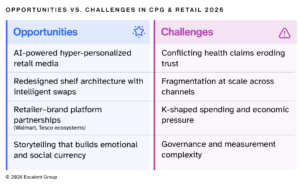
Retailers and brands can now blend first-party data, health tracking inputs and AI-driven nudges to influence decisions in-store, in-app and at pickup. Strong partnerships within retail ecosystems create learning loops that accelerate experimentation.
But credibility stakes are rising. Health “truths” (and fads) evolve quickly so brands must consistently communicate better-for-you values across AI agents, retail platforms and media environments.
When self-regulation rises and appetite appeal drops, the shelf needs to coach and care—not just sell.
Accelerating shifts in consumer behavior
Q: Which consumer behaviors are accelerating fastest—and where is the execution gap?
Three trends stand out:
- Portion logic is flipping. Smaller formats, shared meals and “one purchase, two meals” behavior are reshaping pack sizes and pricing models.
- Agent-assisted shopping is growing. Consumers increasingly rely on AI “coaching,” curated retailer lists and credible brand or product swaps aligned to health goals.
- Convenience continues to redefine retail with exponential growth click-and-collect, app ordering and delivery. Platforms like Grubhub scale across income tiers.
The industry response has been mixed. Retail media ecosystems are expanding rapidly. Brand storytelling is resurging as a trust lever.
But the physical store often remains optimized for impulse. Pricing and promotion rules feel outdated. On-shelf and in-app information rarely adapts to individual needs.
The role of insights in designing influence
Q: How can insights help CPG and retail anticipate change and personalize experiences?
First, brands need to reconsider the customer journey and map new choice architecture. That means combining shop-alongs, ethnography and digital trace data where AI agents are active.
Second, close the “health truth” gap. Translate complex nutrition science into simple, trustworthy guidance that aligns with retailer systems and agent prompts.
Third, design for micro-moments. Identify micro-segments and test modular stories, packs and promotions across aisle, app and pickup.
Finally, prototype future planograms. Co-create shelf layouts, signage and digital layers that help considered shoppers choose faster.
Unified exposure-to-conversion measurement across retail media closes the loop and supports rapid test-and-learn.
One thing brands should rethink
Q: If there’s one thing brands should rethink to stay relevant in 2026, what is it?
Reframe value around outcomes, not volume. Quality, right-sized portions, credible health benefits and meaningful storytelling aligned with customer wellness aspirations matters more than feeding impulses or supersized deals.
Brands must organize for speed and fragmentation. Agile pods serving micro-segments, powered by retailer–brand data and rapid experimentation. The store and app should evolve from catalog to coach.
Key takeaways for CPG and retail leaders
- AI shopping agents are reshaping consumer decision-making
- GLP-1 adoption and health trends reduce impulse and increase agency
- Retail shelf design must move from persuasion to guidance
- Hyper-personalized retail media ecosystems create influence opportunities
- Value must be reframed around better-for-me outcomes, not volume
- Insights must power real-time experimentation and micro-segmentation
The CPG and retail landscape is shifting from impulse-driven demand to influence-driven choice. As AI agents guide shoppers and health priorities reshape behavior, brands must redesign how they show up at the moment of decision. The future belongs to companies that integrate storytelling, shelf architecture, retail media and data into a unified system of influence—one that respects agency while driving growth.
Brands have to adapt. At Escalent Group, we help teams translate change into conversion from insight to execution. If your organization is ready to design influence for the next era of CPG and retail, let’s start the conversation.
Frequently asked questions
1. If appetite appeal is down and guidance is up, what should brands prioritize?
Shift from driving desire to designing influence. That means integrating brand storytelling, retail media and shelf/app coaching into a single decision system—at the exact moment of choice.
2. What does “designing influence” actually look like?
- Intelligent swaps on shelf and product detail pages
- Portion-right packaging
- Outcome-focused value propositions
- Context-aware messaging powered by retailer–brand data