Executive Summary: In health and life sciences market research, the voices missing from a study can matter as much as the ones included. This blog post explores how structural barriers and research bias can leave important patient and caregiver perspectives unheard, the commercial and strategic risks of acting on incomplete insights and how structured dissent (supported by AI), can help organizations identify missed perspectives and build more representative, human-centered research.
A story about a missed opportunity in patient experience research
My husband has lost all of his hearing as a result of a complicated medical condition. I routinely attend his medical appointments to serve as his primary interpreter, advocate and emotional support.
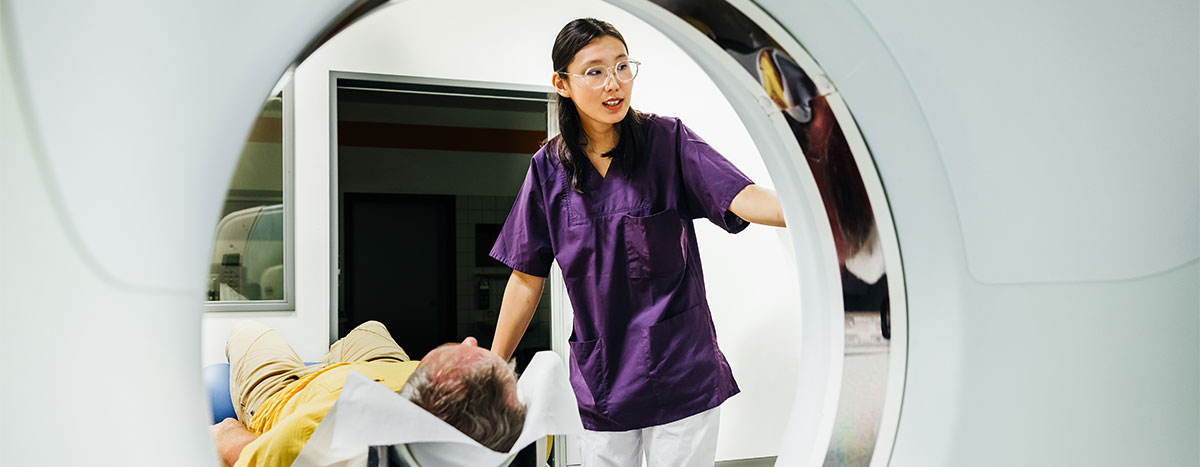
Recently, he was scheduled for a chest MRI. While prepping for the exam, a technologist explained that he would need to hold his breath at specific moments to get the requested images. With his head and chest positioned inside the MRI tube, the expectation was that he would hear a recorded instruction to inhale, hold and then release.
So, I emptied my pockets and stood by his feet after the technologists left the room. For the next 45 minutes, I acted as his ears. Each time the recorded voice instructed him to inhale, I squeezed his foot and held the pressure until the instruction to release.
In those 45 minutes, with nothing but my thoughts for company, I wondered how this exam might have gone if I had not been there, and why MRIs do not include any visual signaling to support patients with hearing loss.
One possibility: the user experience market research did not include patients or caregivers of patients with no or low hearing.

When healthcare research overlooks the realities patients quietly adapt to every day, organizations risk building innovation around the voices that are easiest to reach, not the needs that matter most.
Missing patient voices in market research are not random, they’re structural
Market research aspires to representativeness. Yet in practice, traditional methods often overrepresent those who are easiest to reach: people who are digitally connected and willing to participate in research. Patient voices may be absent because some groups are not reached, cannot fully participate in the research methods used or choose not to engage because of stigma, distrust or other structural barriers. These barriers can disproportionally affect patients with disabilities, sensory or cognitive differences, limited access to care, low health literacy or distrust in healthcare systems.
Decades of market research on nonresponse bias shows that people who decline to participate differ meaningfully from those who do, often along the very attitudes and behaviors under study. Barriers such as accessibility constraints, stigma and distrust reduce response likelihood. Even among participants, social desirability bias can distort findings when respondents provide answers they believe are acceptable rather than what reflects lived experience.
Absent voices paired with persistent biases in well-meaning researchers (e.g., availability bias, groupthink, conformity bias, motivated reasoning and homophily) create confidence in data that may reflect only the most reachable voices.
How missing voices in healthcare market research can prove costly for brands
Because data-based decisions are shaped by who showed up, when key voices are missing, brands face real risk: strategic miscalculations, forecasting errors, reputation risks and missed innovation opportunities. But the consequences aren’t only commercial. Patients and caregivers may be left to navigate unnecessary barriers when accessibility needs are overlooked in research and design. Consider the missed opportunity to include a visual messaging system in MRI machines. Would that offer a differentiating and valuable feature that serves not just my husband but the ever-growing population of aging people with declining hearing?
Looking beyond my personal experience, there are well-known examples of how missing voices in research can create real consequences for brands.
Studies can include the right demographics and still fail to adequately reflect important differences in patient subgroups. Ambien (zolpidem) is a well-documented example of how clinically meaningful patient differences can be insufficiently reflected in early evidence and labeling. Initial dosing guidance did not fully account for sex-based differences in zolpidem metabolism, contributing to increased risk of next-morning impairment in some women. Post-market safety data ultimately led the FDA to require labeling and dosing changes in 2013, creating downstream commercial and operational impacts as manufacturers and healthcare providers updated prescribing guidance, education and safety communications.
The case of Advair Diskus highlights the impacts of patients whose functional limitations make device use harder than a protocol assumes. Dry powder inhalers such as Advair Diskus illustrate a potential missed perspective in research design: practical usability barriers that may not be fully captured in controlled studies. Published inhaler research and RWE show that factors such as inspiratory capacity, dexterity and device technique can affect effective medication delivery and real-world adherence, particularly in older or more functionally limited populations. When these issues are not identified early, organizations may face increased patient training needs, inconsistent real-world use and pressure to simplify device experience or support programs.
Organizations that actively account for silence, dissent and disengagement are not just improving research quality. They are reducing strategic, operational and reputational risk before it reaches the market.
Can the ‘Devil’s Advocate’ approach surface missed perspectives in market research?
As I was squeezing my husband’s foot, my thoughts turned to my work. What could I have done to prevent this?
As researchers, what are the ways we can engage our empathy and imagination when firsthand experience isn’t available? With AI becoming an increasingly powerful tool in the research process, it can be used as a structured critique layer, helping stress-test interpretations and identify where missed perspectives may exist before they’re embedded in findings. AI can help surface where human input is absent, but it cannot replace that input or lived experience it represents.
This is about identifying where those voices may be absent so they can be intentionally included through better recruitment and culturally grounded healthcare research methods.
Applied across the research lifecycle, the ‘Devil’s Advocate’ approach can look like this:
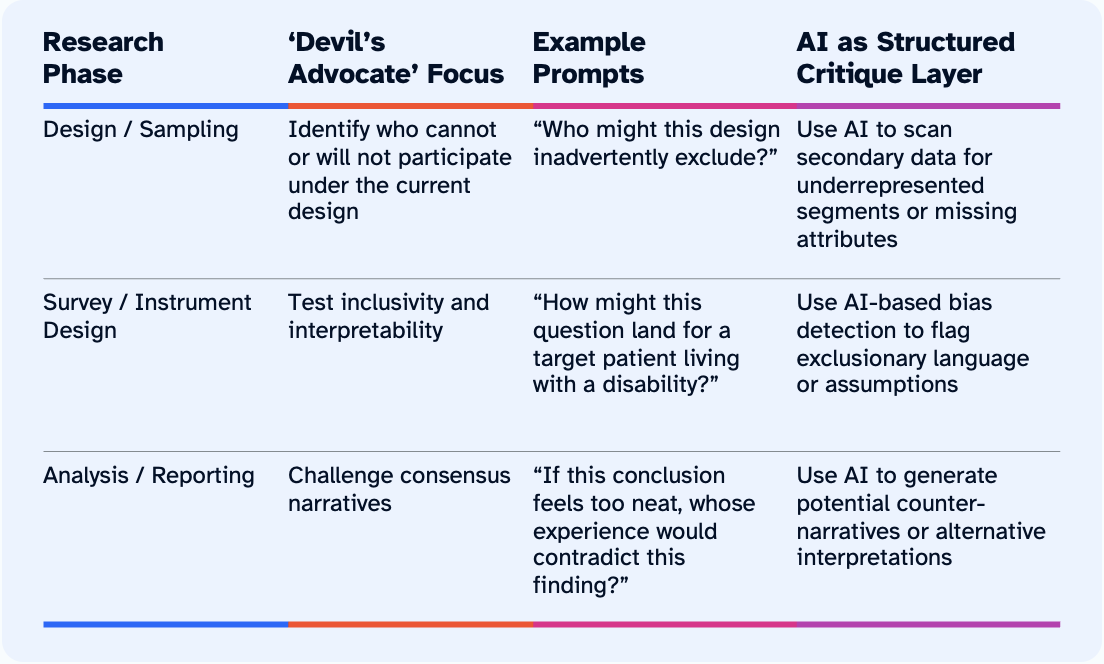
The value of dissent in research is empirically supported and directly relevant to life sciences decision-making, where stakes include patient outcomes, regulatory risk and commercial investment.
The role of dissent and cognitive diversity in improving analytical quality and reducing overconfidence
Life sciences markets are complex adaptive systems involving patients, caregivers, physicians, payers, regulators and advocacy groups. In life sciences market research, counterfactual thinking asks, “What if this interpretation is wrong?” and exposes fragility in assumptions about switching behavior, competitive response and access constraints. Structured dissent increases the likelihood that reimbursement risk, adherence challenges or health equity gaps are surfaced early.
In life sciences market research, dissent can have a clear purpose as a risk management tool. By intentionally introducing friction into study design, recruitment strategy and analysis, teams increase the likelihood that underserved patients, skeptical prescribers or socially sensitive disclosures are meaningfully represented before strategic decisions are locked in.
Why better patient insights require broader representation
Returning to my husband’s MRI experience, a ‘Devil’s Advocate’ might have performed a basic task analysis to identify the abilities and resources required to achieve optimal MRI images. They might have asked whether those abilities and resources were considered across different types of exams, where the patient experience can vary significantly across different accessibility needs and health conditions. Noting that verbal instructions were required for optimal imaging, they might have asked what would happen if a patient could not hear the instructions.
Research seeks to translate human experience into data. But when our work omits the experiences of those who cannot participate, will not participate or do not feel safe participating, our insights fall short of the truth.
The ‘Devil’s Advocate’ exercise is just one way to extend our reach. When we recognize that representation is not only about quotas or demographics, we can begin designing more inclusive healthcare market research that welcomes friction, dissent and difference. Insight, like empathy, grows stronger when we invite the voices that are not yet in the room and design research that makes space for them to be heard.
At Escalent Group, we help health and life sciences organizations uncover the voices traditional research often misses, so decisions are grounded in the full reality of patient experience, not just the perspectives that are easiest to reach. Contact us to learn more.