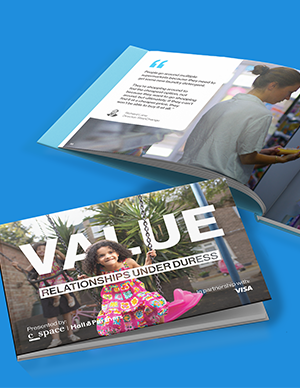
As the cost of living crisis reshapes everyday decision-making, a global payments network needed a stronger, more human way to support its banking clients and their customers. Together with C Space, it set out to move beyond economic commentary, uncovering how financial pressure was affecting people’s lives, relationships and sense of value, and translating that insight into action brands could realistically take.

A global payments network was hearing a familiar question from its banking partners: how are customers coping with rising costs, and what should brands do about it? The problem wasn’t a lack of data—economic analysis was everywhere—but a lack of human clarity. Financial stress was being discussed in abstract terms, while the emotional and relational consequences for consumers remained under-explored.
At the same time, our client wanted to play a bigger role as a financial services thought leader: helping banks and merchants understand their customers more deeply, while positioning itself as a trusted partner in uncertain times. That meant delivering insight that was credible at scale, emotionally resonant and practically useful across multiple markets.


C Space reframed the brief from the outset. Rather than treating rising costs as a short-term cost-of-living issue, the team explored it as an ongoing quality-of-living crisis, one reshaping how people define value, joy and trust in brands.
To unlock these truths, C Space combined broad quantitative validation with therapy-informed qualitative techniques designed to help people talk openly about financial strain. Filmed ethnography, deep interviews and online communities surfaced the emotional trade-offs people were making and the support they wished brands would offer. AI-supported analysis accelerated sense-making across languages and markets, allowing the team to focus on interpretation rather than data reduction.
The insight was synthesized into a simple, action-oriented framework, Relationship Role Models, that showed brands the different roles they could play in customers’ lives, from dependable constant to active advocate. The emphasis was always on enabling action, not just insight.
The work reframed a heavily covered topic with a fresh, human lens and gave brands permission to act differently. For our client, it became the foundation of a European-led thought leadership platform, used in direct conversations with banks and in external communications reaching well beyond its core audience.
A global report, video documentary and multi-brand workshops helped bring the insights to life, prompting senior marketers and insight leaders to rethink how their organizations show up for customers under pressure. Feedback consistently highlighted the power of the reframe and the practicality of the Relationship Role Models in guiding real decisions.
The work continues to be used in client engagements and workshops more than a year on. Evidence that grounding strategy in lived human experience creates insight with lasting relevance.
When uncertainty rises, data alone isn’t enough. Discover how human-centered insight can help your brand build trust, relevance and stronger relationships—when people need it most.

This gave me so much to think about, and there were a handful of very powerful insights. The Boost relationship role model has really stuck with me—asking how brands can provide joy to customers while so many things around them are getting harder.