Executive Summary: What does Gen Z really want from AI in the customer journey? Early insights from C Space’s co-creation workshop reveal three opportunities for brands: challenge assumptions about AI fluency, look beyond AI to understand how customers make decisions and recognize that not every moment of friction needs to disappear.
Is Gen Z ‘bot in’ to AI? It might be more complicated than you think
When we set out to explore how Gen Z navigates an AI-enabled shopper journey, we expected to learn from the most fluent AI users in the market. What we found was more nuanced, and in some ways more useful for brands.
As AI increasingly shapes how consumers discover, evaluate and choose brands, we wanted to understand what this shift really looks like through the eyes of Gen Z, and what it means for brands trying to stay relevant.
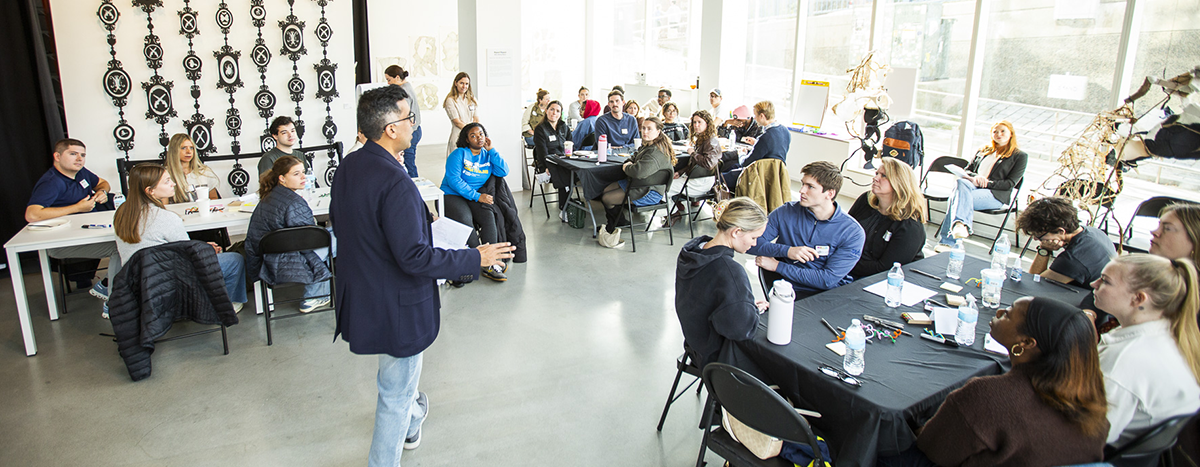
Earlier this month, C Space hosted a half-day co-creation workshop with Gen Z consumers and brand leaders from across industries, including Samsonite, Converse, Dick’s Sporting Goods, Gorton’s and more. Rather than simply asking consumers about their experiences with AI, we invited brands and consumers to work side by side to explore how shopping journeys are evolving, what builds or erodes trust when AI enters the experience, and where brands can add value as AI takes a bigger role in decision-making.
The goal was to begin building a practical playbook for brand relevance in the age of AI, grounded in real consumer experiences and shaped collaboratively with the brands navigating these changes.
While that playbook is still taking shape, the conversations surfaced some compelling early insights, including a few that challenged our initial assumptions.
Our co-creation approach: Exploring the AI customer journey with Gen Z
Rather than presenting our findings to brands, we leveraged C Space’s Big Talk methodology to approach this topic in the spirit of co-creation. Gen Z participants and brand leaders shared tables, mapped shopper journeys together, exchanged perspectives and built toward principles for brand relevance as a group. This approach is the best way to explore new ideas and concepts because it allows for live Q&A (both brands to consumers and consumers to brands), refinement and iteration in real time.
We recruited a wide spectrum of Gen Z AI users, from more occasional users to those more actively experimenting with the technology. While we didn’t include people who reject AI altogether, this range gave us a broad view of what people of all kinds think, feel and experience from AI among this generation.
Here are three early themes that stood out.
1. Gen Z digital natives aren’t necessarily AI power users
We expected a cohort fluent in the full range of AI tools and use cases. Instead, many participants described fairly simple, everyday uses. That gap between assumption and reality matters for brands. Strategies built around a Gen Z power-user mindset may be designed for a smaller audience than expected.
It also raises more questions we want to keep exploring: How do early adopters actually behave differently from everyone else? And how do AI behaviors and expectations differ between Gen Z and older or younger generations?
What brands need to know: Don’t assume digital natives are AI fluent. Validate how your own audience really uses these tools before designing your customer experience around them.

Just because Gen Z grew up with technology doesn’t mean they’re using AI in the ways brands might expect. The opportunity starts with understanding what consumers are actually doing, not what we assume they’re doing.
2. AI is just one part of the customer journey
Participants spoke about their shopper journeys taking many different paths and shapes, but the one need that was consistent across was the need for a vibe check. Whether planning a vacation, buying a piece of furniture or choosing an insurer, they want a way to get a feel for the brand or experience before making a decision. And that rarely meant turning to an AI tool. Instead, this group still relies heavily on social search, visuals and testimonials to assess whether something felt right for them and to make decisions.
What brands need to know: Don’t over-rotate to AI. Optimizing for LLMs matters, but the vibe check still happens in social search. Your brand needs to look and feel right there, too.
3. Friction has value in the AI-powered customer experience
Perhaps the most interesting tension was how selectively participants wanted AI to make things easier. Participants were happy to hand off tasks they didn’t care about, but for things they did care about, they wanted to understand how it worked and valued the satisfaction of doing it themselves. Whether something is worth the effort depends on how much they care about it.
This echoes what we’ve seen elsewhere: customers delegate low-stakes work and take control back when it matters. The co-creation conversations suggest the line is drawn not only by risk, but by passion and curiosity.
What brands need to know: The opportunity may not be removing every step from the journey, but identifying the moments customers want to keep, and making those moments better.
The future of the customer journey isn’t necessarily about making everything faster or easier with AI. It’s about understanding which moments customers want to delegate, and which moments they still want to own—and really understanding why.
What’s next: Co-creating a playbook for brand relevance in an AI age
These three themes are just the beginning. Our Boston co-creation workshop gave us an early look at how Gen Z is navigating AI-enabled shopping experiences and surfaced new questions worth exploring. Next, we’re planning a session in Detroit focused on the Auto industry and another in San Francisco focused on the Tech industry. Each will help us build on these initial insights, explore industry-specific nuances and continue developing a practical playbook for brands.
We’ll share more from Boston, and what we learn next, as the work continues.
Want to be part of the conversation? Contact us to register your interest in joining one of our upcoming co-creation workshops, receiving the playbook when it’s ready, or both.