
Executive Summary: Innovation teams face rising pressure from AI hype, faster market cycles and rising expectations. Drawing on insights from C Space’s Peer Connection session and the Innovation Cookbook, this blog post explores three practical principles that help organizations innovate smarter under pressure.
If you’re like us, you started the New Year desperate for good news. Socially, politically, economically…whatever the flavor, we’ve all been craving a dash of hope, more sprinkles of joy, a healthy dollop of promise. And that feeling was the inspiration for our recent C Space Peer Connection session, Innovating Smarter Under Pressure. While we weren’t in a position to order up world peace, we did want to gather like-minded innovation and customer insight peers to help each other tackle shared challenges—in customer insights and innovation strategy, but also as working humans readying to enter the Year of the Horse.
We’ve appreciated the Chinese zodiac cycle’s symbolism of leaving the Year of the Snake, a time for internal growth, patience, strategy and planning—and entering the Year of the Fire Horse, time for change, energy, bold risk-taking and action.
But while exciting, it’s also a little nerve-wracking. Corporate insights teams are feeling the pressure to act fast and win big, without risking detrimental losses if they make the wrong bets.
Before we could start sharing words of advice, we had to understand what innovation teams are up against today. In just a few minutes, the conversation was close to boiling, with challenges both external and internal, coming thick and fast:
AI. Technical debt. Trends. Differentiation. Thinking big…but not too big (what one colleague called ‘Innovation Yin Yang,’ balancing ambition with practicality). And of course, customer demands.
These are no “small potatoes.”
With so many flavors to choose from, we’ve picked three that seemed to resonate for everyone, regardless of industry or role.
What challenges are innovation and insight teams facing as innovation pressure and AI adoption increase?
1. “Shiny object” syndrome
Many of us talked about the constant pressure to chase new ideas, tools and innovation trends; the need to not look behind the curve, for fear of triggering corporate FOMO.
In innovation, it’s so tempting to jump to whatever the latest fad or technology is as our solution, without really figuring out what we’re doing it for. When everyone is starry-eyed over agentic AI, ‘sleepmaxxing,’ or trend-of-the-moment, it’s worth taking a beat. Reflect on what we know to be true. Prevent ourselves from repeating the days when the solution to everything looked like an app, a virtual reality experience or adding protein.

When innovation chases every new tool or trend, it risks solving for novelty rather than need. The real advantage comes from stepping back and being intentional about which problems are worth solving—and why.
2. The impossible trifecta
Can it really be faster, cheaper and better?
Our tried and tested trade-off triangle, where you could never expect to have all three, seems to have gone up in smoke. CEOs and customers alike are demanding impeccable products and customer experiences, at great prices and service without compromise.
But something has to give, right? In a business world governed by agility, where AI is ubiquitous, even if not well understood or implemented—not so much. Expectations are sky-high, and innovation and insight professionals are being asked to deliver speed, higher quality insights and operational efficiency, altogether like having to dance to a new tune.
3. Sustainable insights?
Real innovation isn’t a next-quarter’s-results game; it demands strategic foresight and staying close to real humans.
The challenge for insight professionals is to identify more evergreen platforms and growth opportunities. It means having a pulse on consumers’ realities today and their fundamental needs. Take pharma or the airline industry, where time to market is often 5-7 years. How do we identify the right signals? How do we focus on those “durable customer needs,” to quote Jeff Bezos, that will still matter in a decade, and not just 2026’s “Color of the Year.” For many who joined our Peer Connection, this is not getting easier, with organizations’ increasing focus on real-time data dashboards and analytics, and a tendency to worship the dashboard rather than worry about the underlying quality of the data.
Sustainable innovation depends less on reacting to real-time signals and more on identifying durable human needs. Without that discipline, organizations risk optimizing for short-term data at the expense of long-term relevance.
The challenges are real. And they are persistent. A quick look at some of the business and innovation trends we highlighted in our Innovation Cookbook helps underscore the challenge, and also some of the root causes.
Just for starters:
- CEO tenure’s down, from 8.1 years in 2024 to 6.8 in 2025, upping the pressure for rapid returns
- Competition is up: pioneers launch 40% faster than others (BCG Digital Challenger Index, 2024)
- As a result, 84% are saying they’re struggling to innovate at market pace (PwC 2023)
- In spite of this, 19% of companies have reduced spend (KPMG Global Innovation Survey, 2023)
- And 42% of global CEOs (+4% vs. 2023) fear their company won’t survive without reinvention
Three practical innovation principles for teams under pressure
To deal with some of the above, we worked together on three principles that can help us all thrive better under pressure.
Principle 1: Make sure you’re solving the right (people) problems
The most successful innovation teams don’t start with technology or trends. They start with people.
Sometimes company culture creates taboos that get in the way of seeing the obvious. We need to listen better: Converse’s waterproof range sprang from online community members venting unasked about the shortcomings of the classic Chuck Taylor during wetter months. So let your customers bring you the brief more!
But it’s also about a behavioral mindset: leaning into human desires, behaviors, habits and cognitive biases to unlock a different set of problems. This means getting closer to lived experience through ethnographic methods, digital behavior labs and re-analyzing customer insight and behavioral data using BeSci models and AI.
Principle 2: Zoom out to see the bigger picture and avoid the echo chamber
Innovation culture is inevitably built from the inside-out. But disruption always comes from the outside.
As Rita McGrath, professor of management at Columbia Business School and author, puts it so beautifully, “snow melts from the edges.”
The centrifugal effect is real and only reinforced by the ‘echo chambers’ we find ourselves in, where nine in 10 trend reports come from the same 10 global cities and our data models are built on yesterday’s data and warmed-up assumptions.
We need to think a little more like Apple, who found the spark for the Genius Bar not inside tech retail but in the archetype of the hotel concierge. Learning from parallel worlds and adjacent industries is always fruitful, and we also need to ask ourselves tough questions about who’s missing from our datasets, taking a more inclusive and human-centered approach to research and innovation design.
Principle 3: Co-create with everyone who has a stake in the solution
Innovation is a team sport, but our mental models for creativity are distorted by the myth of the author. Remember: we are social animals and buy-in is what makes all the difference. And while stakeholders are critical, building for and with consumers is one of the best ways to reduce risk and accelerate timelines.
At C Space, we’ve been practicing co-creation with customers and stakeholders since the turn of the Millennium. We know that it’s a social cocktail: 50% ideas and 50% belief-building. Since stage-gates and silos tend to stifle new ideas, co-creation across functional boundaries is one of the most effective ways to make better progress. Make sure that makers and doers and end users all get involved at the right time.
Bring in R&D sooner. Involve your customers more. Keep tasting the recipe.
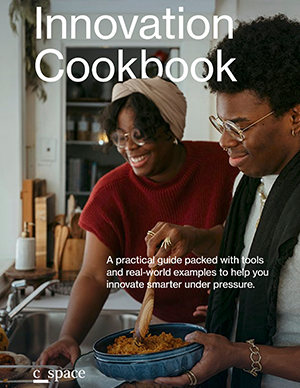
If any of this tickled your palate, why not read more in our practitioner’s guide for insight and innovation leaders, the Innovation Cookbook. It’s packed with ingredients for your innovation bench to help you think more creatively about new ways to innovate smarter under pressure by combining human insight, behavioral science and collaboration.