Executive Summary: Sometimes the best way to solve a problem is to stop looking at it through your own category. Inspired by conversations at our recent innovation event in London—Learning From: Travel, this blog post explores how cross-category thinking can help brands uncover new opportunities, challenge assumptions and build successful innovation from the very beginning.
Why looking sideways is sometimes the best way to move forward
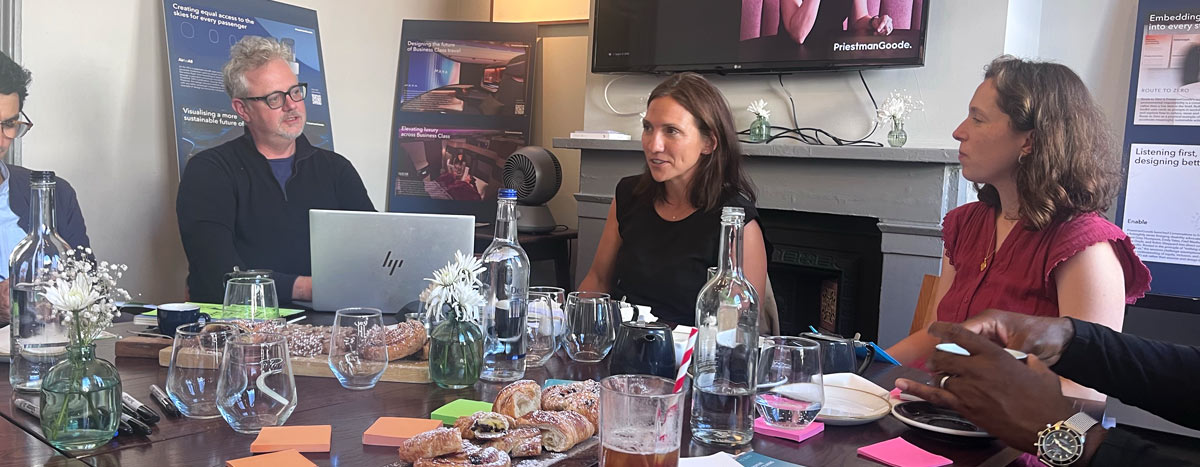
A few weeks back, in London’s Borough Market, C Space hosted Learning From…Travel, a new kind of event where we set out to bring clients from wildly differing categories together to see what new lessons we could learn for cross-industry innovation. Think airlines side-by-side with social media companies, charities and home tech brands, exam boards and hotels, all united in a discussion about innovating smarter in an age of increasing disruption, anchored in cross-cutting human needs.
Travel was our way into the conversation
To give us focus and a start-point, we decided to start with travel. Why?
- Travel’s massive: it makes up one-sixth of global GDP and one-third of jobs worldwide.
- Travel’s resilient: growth shows that the desire to explore isn’t abating, especially post-COVID.
- Travel’s global: it brings together cultures, geographies and people from around the world.
We also welcomed our regular collaborator on rail and airline innovation, Jo Rowan from design agency PriestmanGoode, to share her lessons and insights into how complex, regulated industries can embrace innovation while reducing the risk on their investments.
Among other things, we surfaced familiar innovation barriers:
- The desire to lead versus the fear of going first.
- The need to be brave versus the need for proof.
- The hope of growth versus the demand for results.
These innovation headwinds are not new, but the “impossible trifecta” of faster, better and cheaper, combined with global economics and geopolitics, the rise of AI and other ‘shiny objects’ are not making the innovator’s life any easier.

The challenge isn’t a shortage of ideas. It’s finding the confidence to move them forward. Looking beyond your own category can provide the evidence and perspective needed to make bolder innovation decisions.
Principles for navigating successful innovation
The really good stuff emerged when we realized that we were all asking similar questions in different ways, and how looking through a category microscope blinds us to the existence of the same, whole human who uses all of our services at some point!
It’s where C Space’s 3 evergreen principles come into play:
- Start with problems, not solutions (to address the needs that are worth solving).
- Break category rules for breakthrough growth (to avoid incrementalism).
- Co-create early, often and with everyone who matters (to build belief and solve problems together).
5 tips to show you how these innovation principles work in practice
START WITH PROBLEMS [PRINCIPLE 1]
1. Starting with the problem, not the solution, builds confidence to make bigger, braver innovation moves.
Business travel in airlines has become a real misnomer. In all the documented trends, large proportions of travelers paying for premium cabins are often leisure travelers, particularly after COVID. And that means a rise in “together travel,” with new needs for socializing and sharing space, away from the isolating cocoon of the traditional business class suite. Qatar Airways spotted that shift, and the new problems it could solve, when it developed Q-Suite (a flexible suite offering room for two to four passengers). It is one of the reasons it’s the most award-winning airline (nine times) and winner of World’s Best Business Class Airlines 2025 in Skytrax’s awards.
The best innovation opportunities often emerge when brands stop optimizing existing solutions and start understanding how customer needs are changing.
BREAK CATEGORY RULES [PRINCIPLE 2]
2. How can looking outside your industry drive better innovation?
Proof from other industries enables bolder innovation.
Companies want to be first without being first. Fear of doing something unproven often causes decision paralysis and prevents us from making bold innovation moves. Plus, there’s time, complexity and cost to think about. Looking outside our category at successful innovations provides a fruitful source of inspiration and proof points that something works, making it feel a little less risky to be first in your own category.
PriestmanGoode created Route to Zero toolkit to solve exactly this issue in sustainable innovation. Sustainability can often be sidelined as a sub-item on a design brief. Route to Zero works to inspire bold thinking through showcasing sustainable innovations across parallel industries that are tried and tested. It challenges us to move beyond materials and consider how sustainable practices can be embedded throughout a product lifecycle, emboldening organizations to go first with confidence.

BREAK CATEGORY RULES [PRINCIPLE 2]
3. Borrowing a feeling, not a function
When people hear us talk about cross-category learning, it’s easy to get quickly derailed. Borrowings aren’t often helpful when they’re too literal, though technology implementation or business model adoption is often a great way in. Instead, we see the best innovators translate, adapting feelings and underlying benefits and placing them into new contexts to create breakthroughs.
When Apple invented the Genius Bar, their archetype was the hotel concierge. The giant display tables were inspired by farmhouse tables, the epitome of spaces where people congregate, and when they brought in trees into their stores, it was to create the feeling of a “town square,” their model for social retail.
Cross-category innovation isn’t about borrowing products or features. Rather, it’s about translating the human experience behind them into entirely new contexts.
CO-CREATE [PRINCIPLE 3]
4. Move from thinking to making
By making the thing, you learn, and it’s only in co-creating that you really understand what’s needed to move from idea to reality. PriestmanGoode’s work on Air for All, highlights this process perfectly. It started from an idea: What if we could make air travel more humane for passengers who use wheelchairs by enabling them to bring their wheelchairs onboard a plane?
It was designed as part of a consortium, bringing in someone who could build it, a certification team and the passenger perspective, so it was designed with the needs of the end user in mind. They built the concept and did lots of testing, but there’s always something new to learn during this process. Airlines asked, “But how would you book this? How will passengers communicate what spec their wheelchair is?” Creating this booking system could take two years.
The learning: The more you can talk and engage sooner, the better. You learn in the doing. Don’t be afraid to share imperfect thinking. Co-creating well is complex but bringing in the different range of voices that matter builds successful innovation.

CO-CREATE [PRINCIPLE 3]
5. Why the beginning matters most
Through C Space and PriestmanGoode’s recent cabin innovation work together, one lesson stood out above all others: investing more time at the beginning creates better outcomes at the end. The most successful innovation programs aren’t just about generating ideas, they’re about creating the conditions for great decisions.
As you begin your next innovation challenge, keep these actions in mind to build momentum, create confidence and bring people with you.
Your innovation checklist:
- Start with a shared goal: Innovation moves faster when everyone is working toward the same outcome. Bringing cross-functional teams together early creates alignment on what success looks like, how decisions will be made and what evidence is needed to move forward. When you understand what makes a business tick, you can design a process that helps unlock progress.
- Design for decisions, not just insights: Research is only valuable if it helps people make decisions. Build customer feedback and testing into the process from the start. Real user evidence creates confidence, reduces debate and helps organizations move forward faster.
- Build with the ecosystem: Innovation doesn’t happen in isolation. Involving the people who will ultimately deliver, manufacture or implement an idea helps ensure solutions are both desirable and feasible. It also reduces the risk of the “not invented here” syndrome and increases adoption across the organization.
- Create buy-in along the way: Big innovation decisions rarely succeed through a final presentation alone. The strongest programs bring stakeholders into the journey from the beginning, through workshops, customer sessions and shared learning. When people see and hear customer needs firsthand, those insights become more memorable, more human and more persuasive.