
Executive Summary: The cost-of-living crisis is no longer just changing what consumers buy. It is reshaping how people live, what they value and which brands they trust. As financial pressure becomes a broader quality-of-living challenge, brands need to look beyond price and promotions to understand the emotional trade-offs people are making every day. Those who respond with practical support, transparent pricing and human-centered customer strategies will be better placed to earn relevance, protect trust and stay meaningful in consumers’ lives.
We are all too familiar with the standard narrative around the cost-of-living crisis: prices rise, budgets tighten and brands tweak their marketing. But when you sit with people and really listen to their stories, that framing feels deeply outdated.
In a recent Peer Connection session where we brought together a group of insight professionals to explore the 2026 edition of the VALUE: Relationships Under Duress report (based on research from C Space and our friends at Hall & Partners), a much more human picture emerged. It feels less like a temporary economic squeeze and more like a profound, long-term structural shift in consumer lifestyles and spending behavior of people.
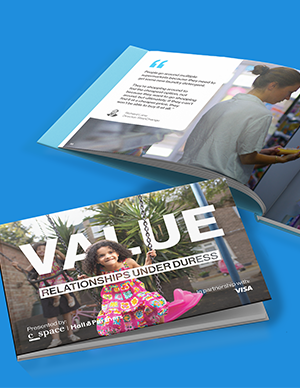
The VALUE report’s research methodology reflects that same depth, spanning nine markets, 12 in-home interviews, 40 digital in-depth interviews and 600 community members, offering brands a richer understanding of how consumers are navigating pressure, making trade-offs and redefining value in everyday life.
In our Peer Connection session, the insight experts in the room quickly moved past inflation metrics. Instead, we talked about something much more intimate: how people (including them) are quietly, persistently editing their lives to cope with rising costs and ongoing financial uncertainty.
For those of us focused on building genuine, lasting relationships under duress, this changes everything about how we need to show up in 2026.

The cost-of-living crisis has become a quality-of-living crisis. Consumers are not simply reacting to higher prices; they are redesigning everyday life around pressure, restraint and emotional trade-offs.
From “spending less” to “living differently”
What struck us immediately was how quickly the conversation moved beyond the simple math of rising prices. The real story isn’t just about paying more. It’s about the emotional toll of reduced spending power / doing less or fundamentally having to do things differently.
Everyday moments of joy
A bunch of flowers, a haircut, a meal out with friends, are being stretched, swapped or sacrificed. Grocery runs mean quietly choosing the own-label brand as consumers prioritize value and affordability. Subscriptions are cancelled with a heavy heart. Social lives are being entirely redesigned around what is affordable in high cost-of-living times.
For parents, this pressure is incredibly sharp
The spending hasn’t disappeared, but it has been reallocated with a fierce protective instinct. Treats are saved for the children, while parents go without. This isn’t just traditional austerity. It is a quiet, continuous and often exhausting recalibration of what a “normal” life looks like now.
The rise of the permacrisis mindset
Perhaps the most vital shift to understand is psychological. Inflation is no longer a sudden shock; it is the air we breathe. The early instinct to hunker down and “pause life until things get better” has given way to a “permacrisis” mindset shaping long-term consumer behavior. People aren’t waiting for a return to normal anymore. They are operating on the heavy assumption that this is normal.
This shift completely alters how people plan their futures and find value in their present. Short-term promotional fixes or reactive, overly cheerful messaging simply do not resonate when consumers are bracing for the long haul.
The widening gap between macro data and lived experience
Even when the news points to economic recovery, the reality on the ground feels starkly different. There is a painful disconnect between macroeconomic signals and real consumer lived experiences, like GDP growth and the daily, grinding friction of making ends meet. If we only look at high-level metrics, we risk a massive blind spot—much like how surface-level data can distort our true understanding of global research programs. This gap shows why brands need deeper consumer insight beyond traditional economic data.
The visible, urgent trade-offs of “heat vs. eat” have evolved into subtler, deeply personal decisions:
- Which streaming service to let go of based on monthly budget constraints
- Which friend’s birthday dinner to skip due to rising costs
- Which small comfort to deprioritize this month as a part of everyday financial trade-offs
- The result is a lingering sense of deficit. Life goes on, but it carries a heavy friction. When brands push optimistic narratives of recovery, it can feel incredibly alienating to someone whose lived reality still feels like a struggle.
Recovery headlines do not erase the emotional friction of daily trade-offs. Brands need consumer insight that captures what people are carrying, not just what the economy is reporting.
Life vs. category rivals: A new competitive landscape
Living in this environment creates an immense cognitive load. People are forced to make deliberate, careful decisions constantly comparing, justifying, and second-guessing every dollar spent. Because of this, the lines of competition have blurred.
Brands aren’t just competing against rivals in their category anymore. They are competing against entirely different life choices:
- A meal out versus a beauty treatment
- Fixing something broken at home vs. a weekend away
Every single purchase is weighed against a broader, deeply personal set of life priorities. It makes earning a place in someone’s life so much harder, and requires us to offer something truly meaningful.
A note on affluence: We must also remember that this anxiety isn’t confined to specific income brackets. While the financial strain is undeniably less acute for higher-income households, the overarching atmosphere of uncertainty still shapes how they feel and act, often leading to a quiet restraint around visible spending. Value-consciousness has become a shared, near-universal mindset across income segments, including higher-income consumers adapting to this uncertainty.
Trust under duress: How can brands build trust when consumers are under financial pressure?
Running through our session was an undercurrent of deep, understandable skepticism. Consumers have been burned, and many now default to the assumption that organizations are looking out only for themselves. Price increases are often felt as corporate extraction rather than operational necessity.
When relationships are under this kind of duress, how we communicate is everything. Tone-deaf or overly polished corporate speak invites immediate cynicism. But stepping back and staying silent is just as damaging. It is read as indifference.
The challenge is to engage with genuine empathy, showing up in a way that is credible, grounded and deeply respectful of what people are going through.
Moving from sympathy to solidarity
Empathy is a beautiful starting point, but right now, people need more than just a listening ear. They are looking for true solidarity. They need practical support, radical transparency and tangible proof that brands are willing to share the burden, not just nod sympathetically.
Solidarity means:
- Clear, honest pricing to build consumer trust during rising costs
- Flexible options when life happens such as payment flexibility or subscription control
- Transparent communication about pricing decisions and business trade-offs
Alongside the practical help, the emotional need for reassurance, stability and human connection is higher than ever.
In a cost-of-living crisis, trust is built through usefulness, fairness and proof. Consumers do not need brands to sound sympathetic; they need brands to behave supportively.
The psychological utility of “small luxuries”
One of the most touching insights was the enduring role of “small treats.” While making sweeping cutbacks, people are still finding ways to hold onto small moments of joy—a really good cup of coffee, a fresh manicure, a favorite snack. These aren’t irrational splurges; they are vital coping mechanisms.
When big milestones like buying a home feel painfully out of reach, these accessible moments of pleasure become lifelines. They offer a fleeting sense of normality, control and comfort.
For brands, this beautifully reframes discretionary spending and that it shouldn’t be dismissed as irrational. It is not just about what people can afford, but about the profound emotional comfort these small things provide.
Navigating the internal tension
We know this creates a tough balancing act for businesses. The pressure to hit commercial targets and satisfy stakeholders is very real, yet it sits right alongside a clear, urgent plea from consumers for fairness and restraint.
Ignoring this tension isn’t an option. Brands that extract too much will break the trust they have worked so hard to build. Those that offer empty empathy without real, tangible value will be seen right through. The true opportunity lies in marrying commercial health with genuinely supportive, human-centered behaviors. Brands that earn relevance in 2026 will not be those that simply acknowledge financial pressure but those who respond to the cost-of-living crisis as a quality-of-living challenge, with clarity, fairness, flexibility and practical support.
Download the 2026 edition of the VALUE: Relationships Under Duress report to explore the research in full. And read the next blog post in the series to discover the five brand archetypes that can help brands stay relevant, build trust and grow through pressure.