
Executive Summary: AI can speed up market research, but it cannot replace the human judgment that turns data into direction. Researchers need five superpowers: curation, challenge, creativity, connection and compassion to make insight more useful, ethical and commercially relevant.
I’m just back from a warm and sunny Esomar Congress in Valencia.
My hot take: the conversation around AI in research has moved on. Synthetic data, digital twins, AI-enabled creative processes and new knowledge platforms are all now real, and the use cases for insight and market research teams are becoming more subtle and nuanced. Like it or not, AI is here to stay. And most delegates, providers, clients and even freelancers seemed re-energized by the possibilities.
But as AI keeps getting faster, smarter and more embedded in how we work, what are we missing? And what’s actually left for us humans to do?
Here’s my belief: AI isn’t here to replace human expertise. It’s here to amplify what makes us special. But only if we can agree what that expertise is in the first place.
The answer’s always seven. Why LLMs often give average answers in market research?
I kicked off my talk with an experiment (thanks to Zoe Scaman, founder and AI strategist). Try it yourself: pull up your favorite LLM and type this in:
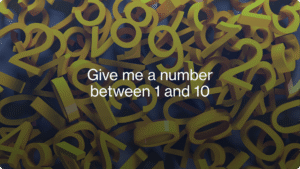
So, what did you get? The answer’s seven. It’s always seven. Push your LLM on why, and you’ll find it’s just assuming you want the average human answer. LLMs are the biggest probability machine ever invented. And that’s a problem. They tend to generate plausible answers over true ones, filtering out the diversity and strangeness that qualitative research, customer insight and human nuance rely on in favor of a normative “majority report.” We can work around that, but it’s embedded deep into the OS.

AI makes average answers easier to reach, but average is not the same as true. The research opportunity is to use AI without letting it flatten human difference.
How insights teams can avoid nostalgia and “shiny object syndrome”
Our industry’s caught in a bit of a bind and we risk making it worse. Sure, traditional research has flaws and AI can help overcome them. From confabulation to say-do gaps, from time to debrief to fieldwork costs and from survey fraud to research operations … the list goes on.
We’ve been here before, and looking back, nobody’s really nostalgic for the old ways. Whether that’s a 12-hour round trip to Paris for a 1-hour meeting, meeting the same “respondent” in both North AND South London workshops being two different people, or manual transcription, most of us embrace the new world with open arms.
Yet there’s so much we still haven’t figured out, and many good ideas that AI research tools are ignoring, from “we research” to co-creation and participatory methods. As we rush to bolt AI onto everything, and make digital twins for everything, there’s a real risk we throw the baby out with the bathwater.
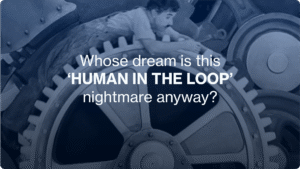
Should researchers be human-in-the-loop or human-in-the-lead?
I don’t know about you, but that phrase worries me.
Should human judgment be part of working with AI? Absolutely, especially in validating and “sign off.”
But language matters. And as researchers, I’d hope we still have a more leaderly role to play. The real question is how do we stay in control and defend our sense of agency? “Human-in-the-loop” has it backwards. That’s a potentially dystopian vision dreamed up by techno-utopians. I want to argue for the opposite: tech in service of humans, not the other way round. Human-in-the-lead, not in the loop.
This might sound obvious, naïve even. But like any good innovation, we need to ask: what problem are we actually solving? Technology should be killing the drudgery—the robotic, joyless tasks behind many errors. Memory, consistency, energy, blind spots, those human frailties are everywhere and AI can shore them up. But automating human bias, giving us the number seven every time, isn’t progress either. So, let’s pause before we leap, replace the human robot and focus on augmenting the seeking human.
The goal is not to keep humans inside an AI process. It is to keep AI in service of human judgment, accountability and better business decisions.
The five human research superpowers
So, what are these mythical human research attributes that still matter as we move into an AI future? I count five.
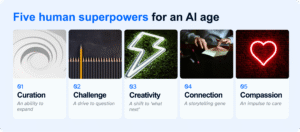
Superpower 1: Curation
Here’s an uncomfortable truth: insight is often not in the research data set.
Too much research is a normative “majority report.” It produces truisms (the ‘bleeding obvious’) or untruths. And on a bad day, AI makes that worse by speeding up the what, so we don’t have time to notice the why. Without judgment, without triangulation, without intuition, we’re not doing our job right.
Great researchers have always done two things: read the negative space, what’s not being said, and used human wisdom to frame the data. At C Space, we do this with a cocktail of consumer and expert testimony, applying BeSci to unpick paradoxes like the say-do gap. The broader point is that AI-enabled research still needs expert framing before it can drive confident decisions.
Sustainability’s a perfect example, as we discovered with our The S Word report.

For example, people who resist the “S label” are often as sustainable in practice as the rest. Conversely, people who know most often downplay their behavior. BeSci calls this the Dunning-Kruger effect. And that’s not new. What is new is training human-guided AI to apply it at scale, so we can run validated models like COM-B across unstructured data.
That makes BeSci more powerful, more accessible and more relevant to AI-enabled insight work. Experts still train it and steer it, but data we’d normally overlook can now be re-mined for fresh insight.
Superpower 2: Challenge
Here’s another uncomfortable truth: the real research questions usually emerge, they’re rarely the ones we set out to ask. Our best work starts by challenging the brief, sometimes refusing it outright, poking taboos and making space for the unexpected. We’re not just here to answer the brief. We’re here to bring it too.
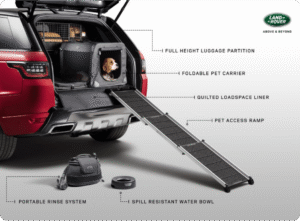
Insight communities are a great way to do exactly that. We always insist on a ratio of 30% user-generated discussions to 70% client questions. It’s not just better for engagement. It’s better for spotting what’s hiding in plain sight. Our JLR’s driver community surfaced a brief nobody was thinking about, catering to dogs. That one, unasked-for, insight sparked a whole wave of exploration and customer-led innovation, culminating in features like these:
Superpower 3: Creativity
For too long we’ve talked about insight like it’s buried treasure, something “out there,” waiting to be mined, found if we just “go deep” enough. That’s not how insight works. Insight is built, it’s shaped, and it has to be connected to an opportunity. It only matters when it unlocks something. We need to move from the what, through the “so what?” to the “what next?” That’s where the value has always lived. And we need AI research tools that can move between those zones, combining data, hunches and trends, to get us to solution spaces faster.
One example is when we helped the Global Hotel Alliance build a new customer proposition called “Live Local,” as shown here from member brand Kempinski.
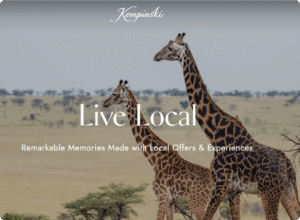
It started with a traveler frustration: hotel loyalty only ever pays off when you’re away from home. We connected that to their brand strategy, challenged the industry and championed independent hotels and grounded it in their business reality. It turns out most loyalty members live within striking distance of a member hotel, and could benefit even when they’re not staying the night. That creative leap gave us local offers, events, access. Now an absinthe tasting at the Corinthia in London is how I get value from my trips to Singapore and Beverly Hills.
Superpower 4: Connection
We tend to think our role in insight work is to provide data. But data’s only half the job. I think we’re in the confidence business. And more data always creates more noise. So, knowing how to connect emotionally is essential. As the neuroscience shows, emotions are an essential component of decision-making. If they don’t feel something, it won’t stick.
And while AI can mimic slick storytelling convincingly, it’s often the rough edges and stories that create the traction. Take McDonald’s, who had all the data in the world, but found their board didn’t really get Gen Z. We created an episodic series called UpClose that featured the same six people, just like on reality TV, with topics changing each week.
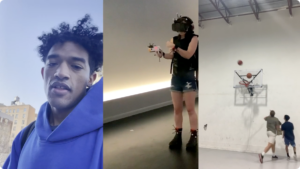
Up Close and Personal with McDonald’s Next Generation of Consumers, Gen Z – C Space
Of course, filming can be expensive. But with more accessible video content and pro post-production tools, we have an opportunity to scale human-led insight storytelling.
Superpower 5: Compassion
I still believe that business and customer shouldn’t be at odds. But innovation often creates disparity as much as solutions. And as researchers, we should care about the outcomes for humans. It’s on us to highlight ethical issues, to push for more diversity and inclusive design, shining a light in places that are often overlooked. To ask, “who’s missing?” and to tackle bias.
We need to ask, “should we?” not just “could we?”
It’s something I’m proud of in the passenger experience research work we do, working with design partners like PriestmanGoode on bringing all abilities into research, even when it’s more work.
Doing the right thing keeps me sane and satisfied that, while we’re not neurosurgeons, we can still aspire to making the world a better place. The role for AI? To create checks and balances, to remind us what we’re overlooking and keep us honest. We can absolutely develop those tools. And we should!